THE NEW YORK SUN NEWSPAPER – TUESDAY, MAY 7, 2002 ARTS & LETTERS
HE BALLET – Going Their Own Way – The Edward Morgan Ballet Celebrates Its Fifth Anniversary – By PIA NORDLINGER
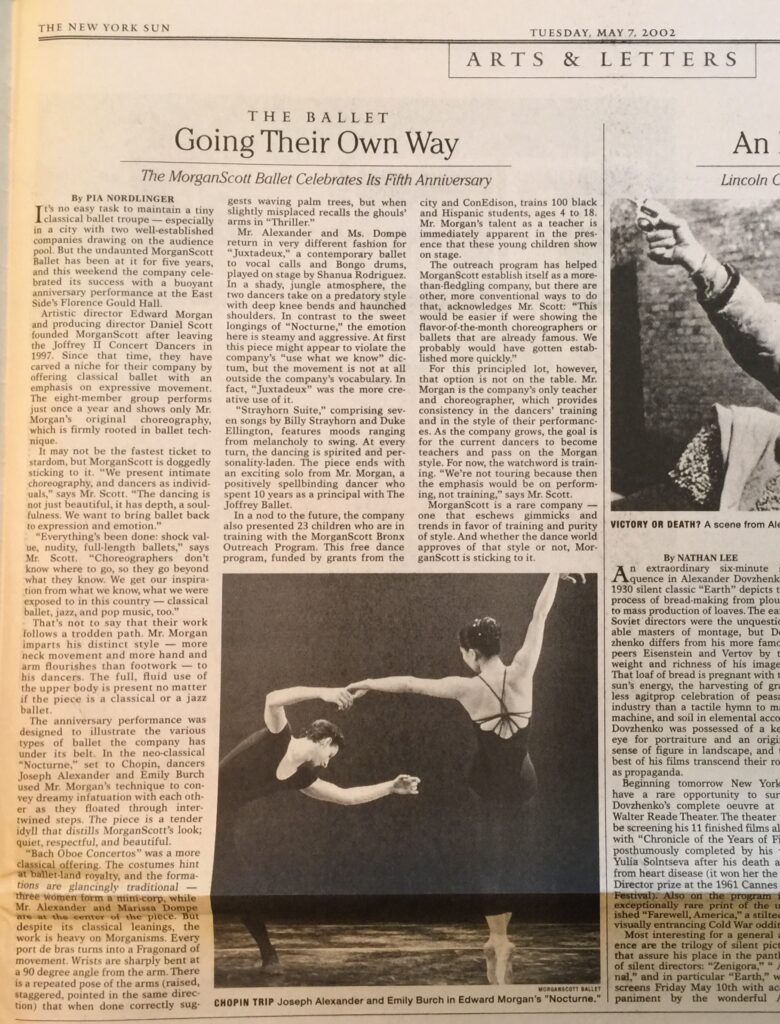
It’s so easy task to maintain a tiny classical ballet troupe – especially in a city with two well-established companies drawing on the audience pool. But the undaunted MorganScott Ballet has been at it for five years, and this weekend the company celebrated its success with buoyant anniversary performance at the East Side’s Florence Gould Hall. Artistic director Edward Morgan and producing director Daniel Scott founded MorganScott after leaving the Joffrey II Concert Dancers in 1997. Since that time, they have carved a niche for their company by offering classical ballet with an emphasis on expressive movement. The eight-member group performs just once a year and shows only Mr. Morgan’s original choreography, which is firmly rooted in ballet technique. It may not be the fastest ticket to stardom, but MorganScott is doggedly sticking to it. “We present intimate choreography, and dancers as individuals,” says Mr. Scott. “The dancing is not just beautiful, it has depth, a soulfulness. We want to bring ballet back to expression and emotion.” “Everything’s been done: shock value, nudity, full-length Mr. Scott. ballets,” says “Choreographers don’t know where to go, so they go beyond what they know. We get our inspiration from what we know, what we were exposed to in this country – classical ballet, jazz, and pop music, too.” That’s not to say that their work follows a trodden path. Mr. Morgan imparts his distinct style — more neck movement and more hand and arm flourishes than footwork – to his dancers. The full, fluid use of the upper body is present no matter if the piece is a classical or a jazz ballet. The anniversary performance was designed to illustrate the various types of ballet the company has under its belt. In the neo-classical “Nocturne,” set to Chopin, dancers Joseph Alexander and Emily Burch used Mr. Morgan’s technique to convey dreamy infatuation with each other as they floated through intertwined steps. The piece is a tender idyll that distills MorganScott’s look; quiet, respectful, and beautiful. “Bach Oboe Concertos” was a more classical offering. The costumes hint at ballet-land royalty, and the formations are glancingly traditional – three women form a mini-corp, while Mr. Alexander and Marissa Dompe are at the center of the piece. But despite its classical leanings, the work is heavy on Morganisms. Every port de bras turns into a Fragonard of movement. Wrists are sharply bent at a 90 degree angle from the arm. There is a repeated pose of the arms (raised, staggered, pointed in the same direction) that when done correctly suggests waving palm trees, but when slightly misplaced recalls the ghouls’ arms in “Thriller.” Mr. Alexander and Ms. Dompe return in very different fashion for “Juxtadeux,” a contemporary ballet to vocal calls and Bongo drums, played on stage by Shanua Rodriguez. In a shady, jungle atmosphere, the two dancers take on a predatory style with deep knee bends and haunched shoulders. In contrast to the sweet longings of “Nocturne,” the emotion here is steamy and aggressive. At first this piece might appear to violate the company’s “use what we know” dictum, but the movement is not at all outside the company’s vocabulary. In fact, “Juxtadeux” was the more creative use of it. “Strayhorn Suite,” comprising seven songs by Billy Strayhorn and Duke Ellington, features moods ranging from melancholy to swing. At every turn, the dancing is spirited and personality-laden. The piece ends with an exciting solo from Mr. Morgan, a positively spellbinding dancer who spent 10 years as a principal with The Joffrey Ballet. In a nod to the future, the company also presented 23 children who are in training with the MorganScott Bronx Outreach Program. This free dance program, funded by grants from the city and ConEdison, trains 100 black and Hispanic students, ages 4 to 18. Mr. Morgan’s talent as a teacher is immediately apparent in the presence that these young children show on stage. The outreach program has helped MorganScott establish itself as a more-than-fledgling company, but there are other, more conventional ways to do that, acknowledges Mr. Scott: “This would be easier if were showing the flavor-of-the-month choreographers or ballets that are already famous. We probably would have gotten established more quickly.” For this principled lot, however, that option is not on the table. Mr. Morgan is the company’s only teacher and choreographer, which provides consistency in the dancers’ training and in the style of their performances. As the company grows, the goal is for the current dancers to become teachers and pass on the Morgan style. For now, the watchword is training. “We’re not touring because then the emphasis would be on performing, not training,” says Mr. Scott. MorganScott is a rare company – one that eschews gimmicks and trends in favor of training and purity of style. And whether the dance world approves of that style or not, MorganScott is sticking to it.
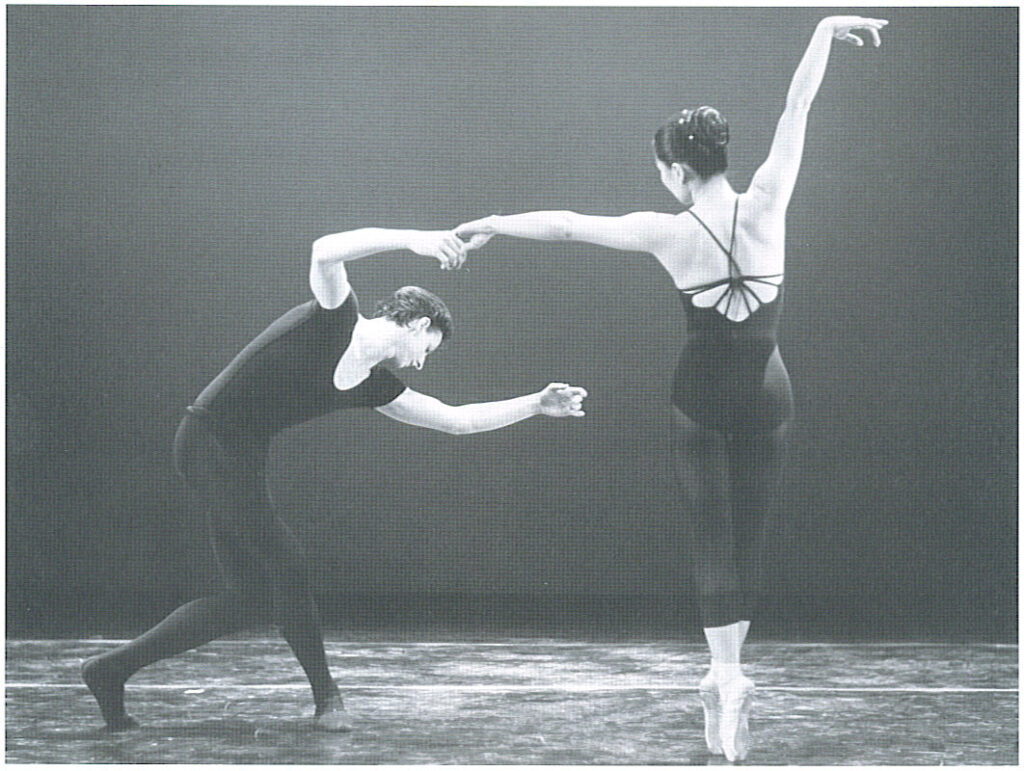
The Edward Morgan Ballet Principals
Joseph Alexander & Emily Burch In Edward Morgan's "Nocturne."