Dance Teacher Magazine – MARCH 2000
EDWARD MORGAN On Giving Students Professional Polish
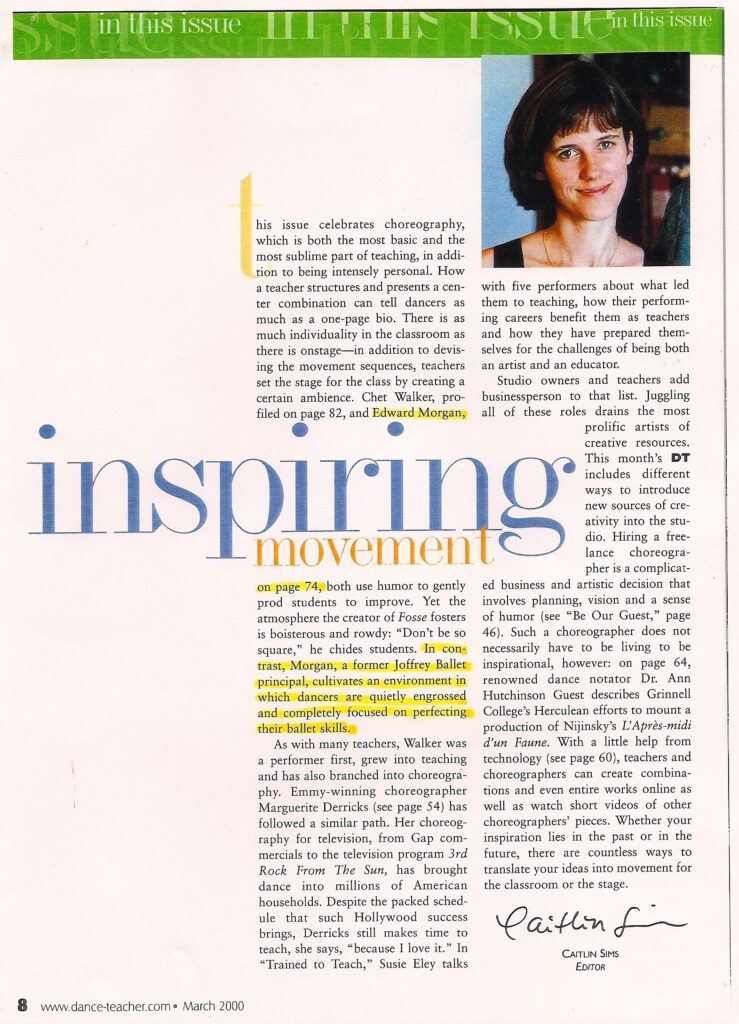
This issue celebrates choreography, which is both the most basic and the most sublime part of teaching, in addition to being intensely personal. How a teacher structures and presents a center combination can tell dancers as much as a one-page bio. There is as much individuality in the classroom as there is onstage—in addition to devising the movement sequences, teachers set the stage for the class by creating a certain ambience. Chet Walker, profiled on page 82, and Edward Morgan, Inspiring movement on page 74, both use humor to gently prod students to improve. Yet the atmosphere the creator of Fosse fosters is boisterous and rowdy: “Don’t be so square,” he chides students. In contrast, Morgan, a former Joffrey Ballet principal, cultivates an environment in which dancers are quietly engrossed and completely focused on perfecting their ballet skills. As with many teachers, Walker was a performer first, grew into teaching and has also branched into choreography. Emmy-winning choreographer Marguerite Derricks (see page 54) has followed a similar path. Her choreography for television, from Gap commercials to the television program 3rd Rock From The Sun, has brought dance into millions of American households. Despite the packed sched- ule that such Hollywood success brings, Derricks still makes time to teach, she says, “because I love it.” In “Trained to Teach,” Susie Eley talks with five performers about what led them to teaching, how their performing careers benefit them as teachers and how they have prepared them- selves for the challenges of being both an artist and an educator. Studio owners and teachers add businessperson to that list. Juggling all of these roles drains the most prolific artists of creative resources. This month’s DT includes different ways to introduce new sources of cre- ativity into the stu- dio. Hiring a freelance choreographer is a complicat-ed business and artistic decision that involves planning, vision and a sense of humor (see “Be Our Guest,” page 46). Such a choreographer does not necessarily have to be living to be inspirational, however: on page 64, renowned dance notator Dr. Ann Hutchinson Guest describes Grinnell College’s Herculean efforts to mount a production of Nijinsky’s L’Après-midi d’un Faune. With a little help from technology (see page 60), teachers and choreographers can create combinations and even entire works online as well as watch short videos of other choreographers’ pieces. Whether your inspiration lies in the past or in the future, there are countless ways to translate your ideas into movement for the classroom or the stage. CAITLIN SIMS EDITOR DANCE TEACHER MAGAZINE
The Flourishing Touch By Kate Mattingly
Pictured - Emily Burch & Joseph Alexander in NOCTURNE
Photo Tom Brazil
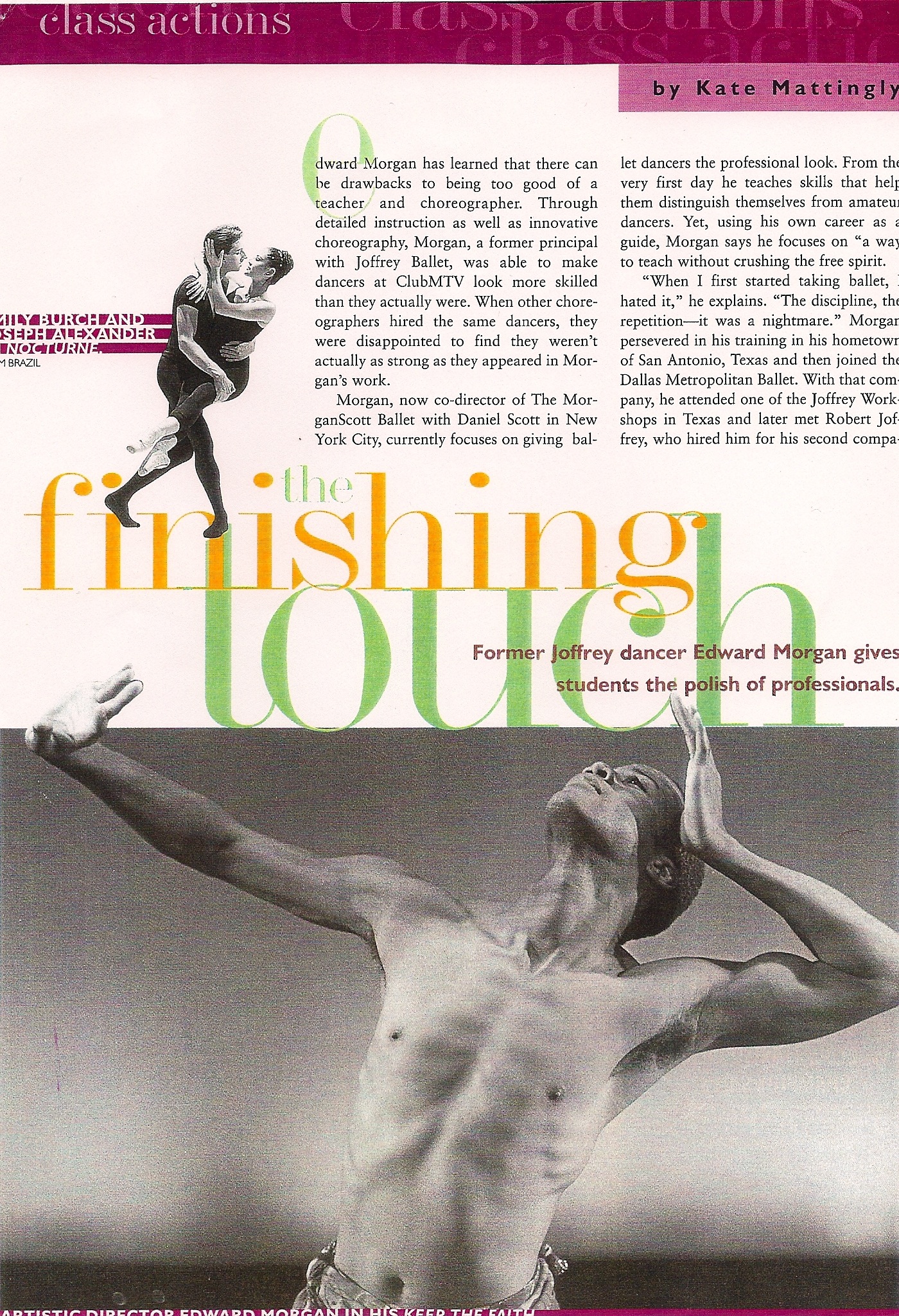
ARTISTIC DIRECTOR EDWARD MORGAN IN KEEP THE FAITH
Edward Morgan has learned that there can be drawbacks to being too good of a teacher and choreographer. Through detailed instruction as well as innovative choreography, Morgan, a former principal with Joffrey Ballet, was able to make dancers at ClubMTV look more skilled than they actually were. When other choreographers hired the same dancers, they were disappointed to find they weren’t actually as strong as they appeared in Morgan’s work.
Morgan, now co-director of The MorganScott Ballet with Daniel Scott in New York City, currently focuses on giving ballet Dancers the professional look. From the very first day he teaches skills that help them distinguish themselves from amateur dancers. Yet, using his own career as a guide, Morgan says he focuses on “a way to teach without crushing the spirit.”
“When I first started taking ballet, I hated it,” he explains. “The discipline, the repetition—it was a nightmare.” Morgan persevered in his training in his hometown of San Antonio, Texas and then joined the Dallas Metropolitan Ballet. With that company, he attended one of the Joffrey Workshops in Texas and later met Robert Joffrey, who hired him for his second company.
Former Joffrey dancer Edward Morgan gives students the polish of professionals
Pictured Below EDWARD MORGAN TEACHING AN INTERMEDIATE-CLASS.
class actions
“I think my lyrical quality, in adagio in particular, captured Loffrey’s] attention,” explains Morgan, whose long limbs and tall frame are ideal for ballet. Morgan danced as a principal with The Joffrey for 10 years and taught and directed the Joffrey II Concert Dancers.
Morgan has also dabbled in jazz and hip-hop choreography. While watching ClubMTV on television one day he decided that the onscreen dancers could use some choreography help and contacted the show to offer his services. He was hired to choreograph fashion shows and was later made choreographer of the show. It was on ClubMTV that Morgan began working with Scott, then a producer.
“If it wasn’t for Daniel, none of this would be happening,” says Morgan. By “this,” Morgan is referring to the school and company that Morgan and Scott established in New York City after The Joffrey Ballet Of Chicago terminated The Joffrey II Concert Dancers in 1997. Finding themselves suddenly without a company, Morgan and Scott launched The MorganScott Ballet to showcase Morgan’s choreography. Reviews in The New York Times have praised the company’s entertaining performances.
Morgan’s talent as a coach and teacher is evident in his company’s dancers. At a recent informal showing at New York’s City Center studio, Morgan performed with principal dancers Emily Burch, Joseph Alexander and LunShan Liao. In the intimate setting of a studio without theatrical lighting or wings, the MorganScott Dancers were comfortable performers with an elegant presentation. Their focus was crystal clear, which enhanced their épaulement and lines. Morgan’s choreography ranged from a dramatic pas de deux to a more modern ballet in which the dancers shouted and swiveled like automatons.
The MorganScott School was started in September 1998 in New York in response to requests for Morgan’s classes. Students in his intermediate-level class display the work ethic and commitment of professional dancers. They are extremely disciplined and practice steps in between combinations. Although they are just 14 years old, these dancers’ desire to learn and improve is evident throughout the class. How does Morgan create polished performers from students? “I teach the kids that there is an audience from the very first day,” he explains. I teach that when you are standing at the barre looking over your shoulder, you are looking at the audience. I find that kids respond to that kind of focus. Everything is a performance-within reason. Anything good, when overdone, is bad, ” he adds with a laugh.
Morgan also focuses on the details that make the difference between pros and amateurs. “I teach them specific things, like a way to perform through the arms and head,” he says. Starting with the very first port de bras at the barre, students are asked to concentrate on the placement of their heads. This in turn makes it easier for them to use the upper body when they progress to combinations in the center. It also reminds them that every part of the body is involved in dancing.
Morgan believes that many talented dancers quit dancing because they lose the passion for move ment. “You have to give students different things that bring out their personality,” he says. In an artform as codified and disciplined as ballet, this can be difficult. “The hard thing about ballet,” he continues, “is you have to be firm, but let students know you care. You can get people to do anything if they feel good about themselves. And we all have something we can feel good about.” The constructive environment that Morgan creates in the company and school was palpable at the City Center showing. Morgan congratulated the performers after each piece-sometimes even in the middle of a particularly difficult section of the choreography. While his level of commitment to each dancer is unique, Morgan uses a traditional structure for his ballet classes. Distinguishing aspects include a preference for slightly lower arms, which Morgan believes strengthens the torso. For pirouettes, he asks that students
Picture Below – EMILY BURCH, JOSEPH ALEXANDER AND LUSHAN LIAO IN MORGAN’S THRESHOLD OF PASSAGE
prepare in a centered fourth-position plié as opposed to a lunge with weight on the front foot. He also asks the students to bring a small pad of paper and pen to class so that corrections can be written down and remembered throughout the year.
One of his particularly effective pedagogical techniques is to ask a student to demonstrate a combination after he gives it. This allows Morgan to check whether he or she has understood the exercise. By varying the demonstrator, the students do not interpret the attention as favoritism or being singled out. Morgan’s students seem to relish the opportunity to show that they have learned the exercise, which is then repeated by the class as a whole.
Morgan’s manner is engaging and gen- tle: Corrections are not screamed, but are firm and sprinkled with humor. “Don’t let your hips go to Hawaii,” he reminded his students as they did fast dégagés to the side. He promotes an atmosphere he calls “constructive competition.” Rather than have students compete against one another, he believes, “It’s better to be the best that you can be.”
Classes are kept to a maximum of eight students so that dancers receive individual attention. Company members also teach students. “Instead of having ideological arguments about teaching with outside teachers, we decided to have dancers from the company teach because they are convinced that this system works,” explains Scott. “One reason we didn’t perform so much last year is because we started the training program.”
When he choreographs for the company, Morgan collaborates with Scott, who selects music and provides concepts and ideas for ballets. What advice does Morgan have for fellow teacher-choreographer-dancers? “If you are really free and excited about what you’re doing, all of the turns and everything else become better,” he says. “I just recently really started to dance!” DT
Kate Mattingly is a freelance writer in New York City.
The MorganScott Ballet performs two programs and five world premieres at the Pace Downtown Theater, March 30 to April 2. For more information, contact the company at 212-439-4615 or the box office at 212-346-1715.