
Dance Magazine – September 1988 – Jim Williams
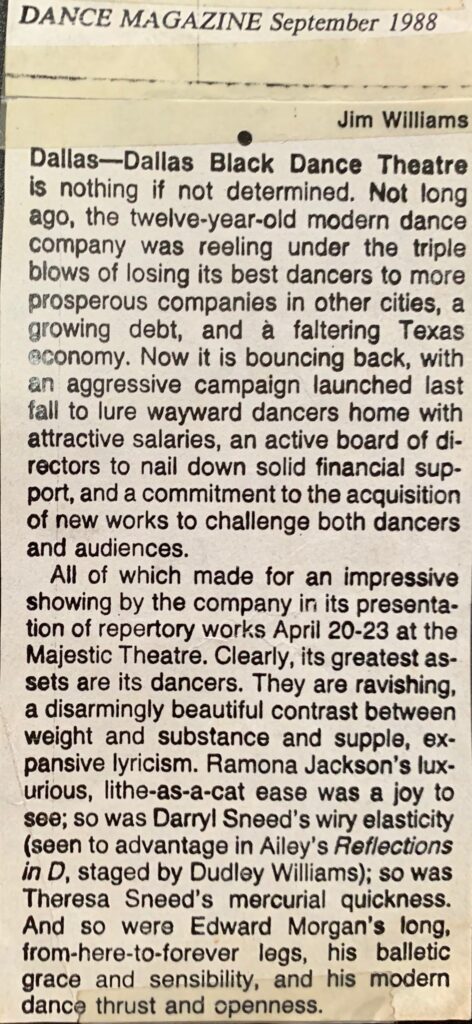
“Edward Morgan’s long from-here-to-forever legs, his balletic grace and sensibility, and his modern dance thrust and openness.”
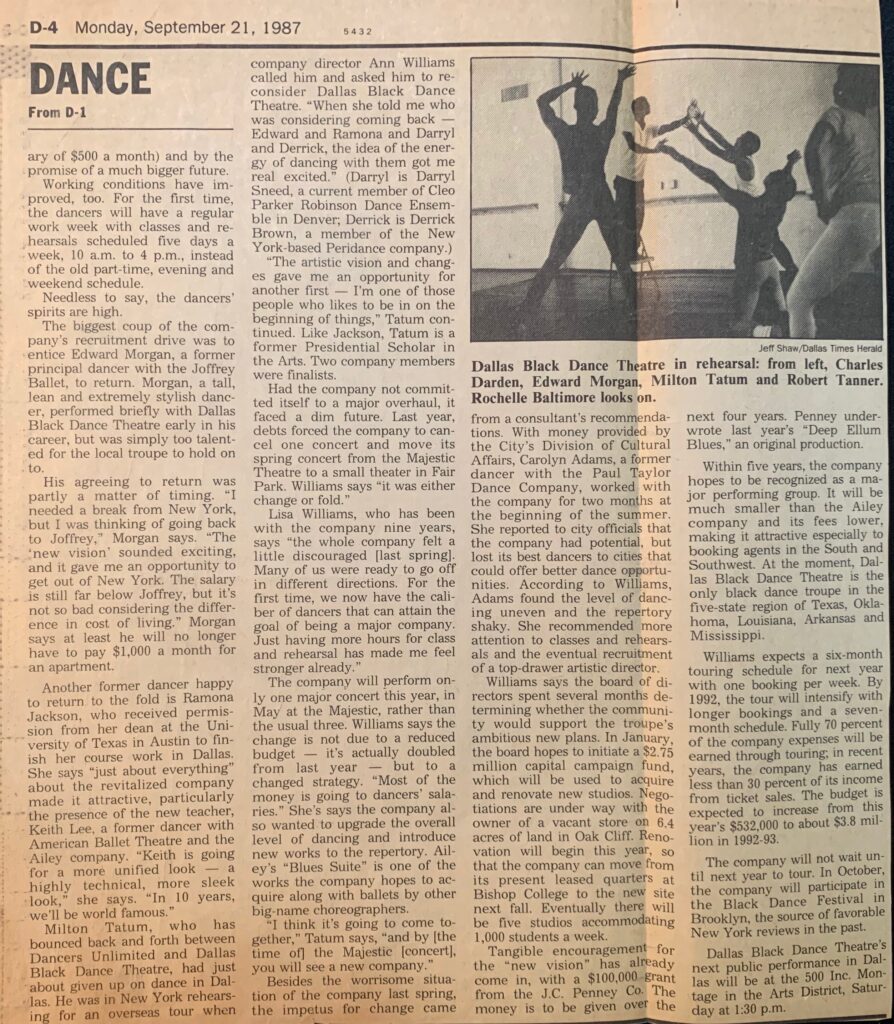
Dallas Times Herald – Dallas Black Dance Theater – Edward Morgan
DANCE MAGAZINE September 1988
Jim Williams Dallas-Dallas Black Dance Theatre is nothing if not determined. Not long ago, the twelve-year-old modern dance company was reeling under the triple blows of losing its best dancers to more prosperous companies in other cities, a growing debt, and faltering Texas economy. Now it is bouncing back, with an aggressive campaign launched last fall to lure wayward dancers home with attractive salaries, an active board of di- rectors to nail down solid financial sup- port, and a commitment to the acquisition of new works to challenge both dancers and audiences.
All of which made for an impressive showing by the company in its presentation of repertory works April 20-23 at the Majestic Theatre. Clearly, its greatest as- sets are its dancers. They are ravishing, a disarmingly beautiful contrast between weight and substance and supple, expansive lyricism. Ramona Jackson’s lux- urious, lithe-as-a-cat ease was a joy to see; so was Darryl Sneed’s wiry elasticity (seen to advantage in Ailey’s Reflections in D, staged by Dudley Williams); so was Theresa Sneed’s mercurial quickness. And so were Edward Morgan’s long, from-here-to-forever legs, his balletic grace and sensibility, and his modern dance thrust and openness.

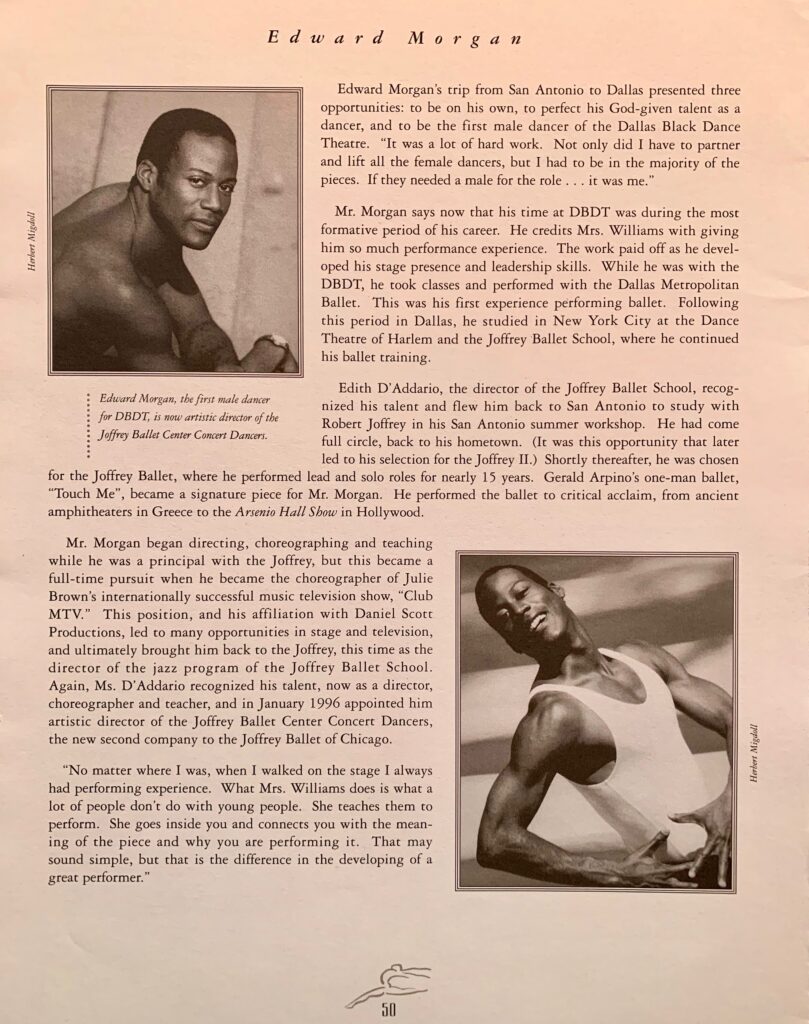
Edward Morgan’s trip from San Antonio to Dallas presented three opportunities: to be on his own, to perfect his God-given talent as a dancer, and to be the first male dancer of the Dallas Black Dance Theatre. “It was a lot of hard work. Not only did I have to partner and lift all the female dancers, but I had to be in the majority of the pieces. If they needed a male for the role… it was me.”
Mr. Morgan says now that his time at DBDT was during the most formative period of his career. He credits Mrs. Williams with giving him so much performance experience. The work paid off as he devel- oped his stage presence and leadership skills. While he was with the DBDT, he took classes and performed with the Dallas Metropolitan Ballet. This was his first experience performing ballet. Following this period in Dallas, he studied in New York City at the Dance Theatre of Harlem and the Joffrey Ballet School, where he continued his ballet training.
Edith D’Addario, the director of the Joffrey Ballet School, recognized his talent and flew him back to San Antonio to study with Robert Joffrey in his San Antonio summer workshop. He had come full circle, back to his hometown. (It was this opportunity that later led to his selection for the Joffrey II.) Shortly thereafter, he was chosen for the Joffrey Ballet, where he performed lead and solo roles for nearly 15 years. Gerald Arpino’s one-man ballet, “Touch Me”, became a signature piece for Mr. Morgan. He performed the ballet to critical acclaim, from ancient amphitheaters in Greece to the Arsenio Hall Show in Hollywood.
Mr. Morgan began directing, choreographing and teaching while he was a principal with the Joffrey, but this became a full-time pursuit when he became the choreographer of Julie Brown’s internationally successful music television show, “Club MTV.” This position, and his affiliation with Daniel Scott Productions, led to many opportunities in stage and television, and ultimately brought him back to the Joffrey, this time as the director of the jazz program of the Joffrey Ballet School. Again, Ms. D’Addario recognized his talent, now as a director, choreographer and teacher, and in January 1996 appointed him artistic director of the Joffrey Ballet Center Concert Dancers, the new second company to the Joffrey Ballet of Chicago.
“No matter where I was, when I walked on the stage I always had performing experience. What Mrs. Williams does is what a lot of people don’t do with young people. She teaches them to perform. She goes inside you and connects you with the mean- ing of the piece and why you are performing it. That may sound simple, but that is the difference in the developing of a great performer.”